


 Apple Podcasts
 Spotify
 Amazon Music
 YouTube
 Castro
 RSS Feed
 Is That an Aga? Birding, Storytelling, and Sustainability on the Mariana Islands
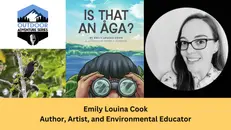
Welcome back to the Outdoor Adventure Series! In this episode, Howard Fox sits down with Emily Louina Cook—author, artist, and environmental educator—to celebrate the launch of her new illustrated children’s book, "Is That an Åga?"
Emily shares her passion for environmental education, her unique journey from growing up on a conservation tree farm in Maine to fieldwork in the Mariana Islands, and the story behind the critically endangered Mariana Crow (Åga). Whether you’re an aspiring naturalist, a lover of wildlife, or a fan of children’s literature, you won’t want to miss this inspiring conversation!
Is That an Aga? Birding, Storytelling, and Sustainability on the Mariana Islands
Welcome back to the Outdoor Adventure Series! In this episode, Howard Fox sits down with Emily Louina Cook—author, artist, and environmental educator—to celebrate the launch of her new illustrated children’s book, "Is That an Åga?"
Emily shares her passion for environmental education, her unique journey from growing up on a conservation tree farm in Maine to fieldwork in the Mariana Islands, and the story behind the critically endangered Mariana Crow (Åga). Whether you’re an aspiring naturalist, a lover of wildlife, or a fan of children’s literature, you won’t want to miss this inspiring conversation!
DISCUSSION
Emily's Background and Education
- Growing up on a tree farm in Maine, and an educational trajectory
- Pursuing a Career in Environmental Education
- The Importance of Protected Area Work
Experiences in the Mariana Islands
- The Marianas as a U.S. Territory/Commonwealth
Pre-arrival Knowledge and Work in the Marianas
- Early awareness of the Marianas via David Quammen’s "Song of the Dodo"
- Work and adaptation to life on Rota/Luta
Discovery and Study of the Åga (Mariana Crow)
- Difficulty among residents in identifying the Åga
- Similarity to other birds on the island; lack of local recognition
- Distinguishing the bird for conservation and research
The Uniqueness and Importance of the Åga
- Charisma and personality of the Åga
- Endangered status and lack of awareness
Threats and Conservation Challenges for the Åga
- Historical range
- Brown tree snake introduction & Habitat loss
- Conservation actions
Motivation and Creation of "Is that an Åga?" Children’s Book
- Incorporating storytelling in environmental education curricula
- Lack of representation in children's picture books
- Observations on local curricula and the need for place-based materials
Website Tour
- Writing, art, and environmental education
- Blog posts and magazine publications
- Pre-order promotion: first 40 pre-orders receive greeting cards; additional giveaways for International Crow and Raven Appreciation Day
LEARN MORE
Learn more about Emily:
Website: https://emilylouina.com/
Pre-order, Is That an Åga? - https://uogpress.com/products/is-that-an-aga
Etsy Store: https://www.etsy.com/shop/EmilyLouina
Super Typhoon Sinlaku Relief: https://give.uog.edu/campaigns/sinlaku-relief/
CREDITS
Åga Photos: Rachael Kaiser
Illustration: Joanne F. Almajose (JoyAlma)
Dive Shop: Blue Palms Dive Service
NEXT STEPS
Visit us at https://outdooradventureseries.com to like, comment, and share our episodes.
KEYWORDS
Emily Louina Cook, Is That an Åga, Outdoor Adventure Series, OWAA, Podcast Interview
#EmilyLouinaCook #IsThatAnÅga #OutdoorAdventureSeries #OWAA #PodcastInterview
My Favorite Podcast Tools:
- Production by Descript
- Hosting Buzzsprout
- Show Notes by Castmagic
- Website powered by Podpage
- Be a Podcast Guest by PodMatch
- Banner Customization by Nano Banana & Canva
Howard_00
Hello everyone, this is Howard Fox, and welcome back for another episode of the Outdoor Adventure Series. Emily Lewina Cook is our guest today on the podcast. Emily is an author, artist, and environmental educator. She's a fellow member of the Outdoor Writers Association of America. And she is joining me today to celebrate the publishing of her new illustrated children's book, Is That an Aga? Emily, we finally got you on the podcast. Welcome.
Emily_02
I know. Thank you so much for having me and inviting me all those years ago. I'm glad it's finally happening.
Howard_00
Yeah, it seems like so many years ago, but I know it's only been a couple. And but you're here, and we're going to talk about. I know this book has been on the radar for quite a while, and now it's coming to fruition and really kind of excited to chat a little bit about it and also to share a little bit about your background. So much is taking place in the in our country right now, and globally for that matter, around the environment. And but the the importance of environmental education is so important. And the work that you have been doing, I really would love to share that with our audience. And first off, for our our audience's benefit, where are you located?
Emily_02
Uh I am currently based in the state of Maine, which is where I grew up. I grew up on a tree farm, actually, but not the way a lot of people envision. So a lot of times I say that and people think, oh, it's a Christmas tree farm where people come and cut down trees. That's not the case. It's just a designation that we have, and we have to allow a certain amount of timber harvesting every so many years to keep that designation. But mostly the tree farm is conservation land, essentially, that we don't plan on developing.
Howard_00
Okay. And what has been your kind of like your education trajectory? Because I know you you're working, you're you're still pursuing advanced uh degrees, and I know that's takes up a lot of time, a lot of energy. The the book, which we'll we'll chat a little bit about, uh is that an Aga. But tell us a little bit about your background. How did you get so interested in environmental education? And I also know you've got a huge artistic background as well.
Emily_02
Yeah, that that's a that's a loaded question. I'll try not to speak too much on this. I mean, I I always feel like I had an interest in the environment and animals, even before I went to college. And then fast forward, I got my undergrad degree at Eckard College in St. Petersburg, Florida, in environmental studies with a minor in visual art. And after graduating from there, I worked as a seasonal biologist, environmental educator, biological technician. They all have slightly different names for a lot of organizations. At the time, that was some of the only work you could get in the field. It was 2008, like right in the midst of that recession. But once I started doing it, I found I really enjoyed it because I got to travel and work with a lot of different species and environments and cultures and meet new people. So it was fun and exciting, not lucrative, but I gained a lot of experience. And eventually I got a position on the island of Rhoda or Luta in the Mariana Islands, where I encountered the Aga, the Mariana crow. Experiences there inspired me to finally pursue my master's degree uh related to the bird, which we can we can come back to and expand on later. And I'm now partway through my PhD in sustainability education. Did that use quite a that answer the question?
Howard_00
That's quite a trajectory. So you grew up in Maine, you ended up going to school in Florida. I had the pleasure a couple years ago of interviewing a lot of staff with the National Marine Sanctuaries. And it just seemed like this whole idea of all these sanctuaries throughout the the US, some are inland, some of the inland lakes, some of them are on the coast. And it seems like that there was a growing passion for the folks in this profession and kind of the work that you were doing in the environmental education, that it it it would be a lucrative career. Is that the do you find it is it is it too specialized? There's some areas are more lucrative than others?
Emily_02
That's a great question. It's difficult for me to say. So especially with protected area work, a lot of the positions and research surrounding that are federally funded, grant funded, and funding, as we all know, can fluctuate sometimes substantially administration to administration. So there's some of that going on. It's it's also just a very competitive job market everywhere, I think. And it's really hard to break out of the temporary seasonal roles and get something that is full-time.
Howard_01
Okay.
Emily_02
But yes, I've I've done a lot of work in protected areas. I've always been drawn toward endangered species in particular. And a lot of these protected areas tend to be strongholds for species that are threatened. That being said, especially directly out of undergrad, I took just about anything that was offered to me.
Howard_00
Well, uh, and I love the fact I'm it was funny. Yesterday I was I I don't really watch TV per se. I watch a lot of YouTube videos. And there's this guy yesterday who had his his show or his speech about yes, you can live anywhere outside of the United States, and most people don't realize there's a lot of US territories that you can live in. And I actually discovered yesterday because I didn't know the answer to this question, I didn't know to ask this question, but the Marianas are actually US territory.
Emily_02
Yes. So this is something that uh I talk about a lot with the book and my research. And this island chain in particular is interesting because we have a U.S. territory and a U.S. Commonwealth within the entire geographical chain. So the island of Guam, which is the island most people tend to be familiar with, is a U.S. territory. The rest of the islands, the Commonwealth of the Northern Mariana Islands, are a U.S. Commonwealth. So they're very similar, but there is a slight distinction between them.
Howard_00
Okay. Yeah, because I'm always looking for my next place to live and something that's a little lower cost to live in. And I thought, oh, Marianas, I should I should ask Emily about that. But so you you ended up in the Marianas. What did you know about that area before you took this pos took this position and did started to do the research? What did you know about it?
Emily_02
Good, good question. I was familiar with them. We can actually blame or credit, depending on how you want to look at it, the author David Quoman for sparking my interest in these islands. He wrote a book called Song of the Dodo, which is where I first read about the Aga, the Mariana Crow. So it had been in the back of my mind since undergrad. And then I was also fortunate enough to go on an undergraduate trip to some islands, including Guam. So that was my first exposure to the islands. And then, you know, like fast forward many years going through many different seasonal uh positions, I did a lot of work in Hawaii, which is another very isolated island chain in the Pacific.
Howard_00
I'm sorry to hear that, by the way. I don't know why anybody would have been allowed to go to Hawaii.
Emily_02
It was, yeah, it was so hard. But yes, I've always been very interested in islands as well, island biogeography, island species. Islands tend to hold more unique species than ecosystems. So it was just a natural progression for me. So being living in Hawaii for so many years, I you know became additionally aware of other Pacific Islands, including the Marianas.
Howard_00
Okay. So when you went to the Marianas, how long were you there?
Emily_02
I was there a little less than a year, uh, the first time helping with a biological research study.
Howard
Okay.
Emily_02
And I went back for my master's research a few years later and was there three, about three months.
Howard_00
Okay. On a scale of one to ten, that's a very coaching question, I would ask, by the way. How in those that that less than a year, that three months, on a scale of one to ten, how did you acclimate to being there and being a part of the not only the community that you lived in, the education community, the the the folks that live there, I don't even know what you call them, citizens of the Marianas.
Yep.
Emily
So yeah, I mean, yeah, and and in many ways, U.S. citizens.
Howard_00
They are U.S. citizens. How did you acclimate to that? Uh like so. One is like I couldn't wait to leave, and ten is like I I didn't want to go.
Emily_02
Well, I I was very excited to go. I'd been wanting to see this bird, the Aga, for many years. From the first moment I read about it. Again, thank you, David Kwaman. And because I'd done so much work in subtropical environments, I adapted pretty quickly physically to the challenges of the work and living there. It was very, very hot. Some of the most challenging field conditions I've worked in. We we we might get a guest appearance from the dog right now. He's uh he's barking a little bit and just okay.
Emily_00
So his his care package is arriving.
Emily_02
All right, it might, it might, it might be. Uh sorry, crunch distracted me.
Emily_00
Thank you, Crunch.
Emily_02
Adapting adapting to the island. Crunch with a K.
Howard_00
With a K.
Emily_02
Well, everyone's clear, that's important.
Howard_00
Okay, we need a picture of of Crunch and you for the for our show notes, by the way. No pressure.
Emily_02
Definitely include one, yes. He's been very helpful with all my writing work the last two years.
Howard_00
I bet.
Emily_02
But yeah, so adapting to the islands. Physically, I adapted quite quickly to the conditions. I was quite busy when I was there, but there were opportunities to spend time with community members. And actually, it was during that process, like those moments with people at the community when they would stop and talk to me, like on the side of the road when I was doing radio telemetry studies or just walking back to the truck from chasing a bird to try to make sure it was still alive and doing well. That I realized that many people could not identify the Aga, the Mariana crow, compared to similar, you might say, look-alike birds on the island, which was very surprising to me because aga are the only crow in those islands. They are restricted to the island of Rhoda or Luta. Luta is the traditional name of the island. And beyond that, they are the only Corvid in Micronesia.
Emily_00
Corvid.
Emily_02
So cor yeah, so Corvid includes crows, ravens, rooks, like a number a number of birds. So they are incredibly unique to the region. So I was surprised when people would say, Oh, I I saw an ag over here doing this. And I would ask a few follow-up questions and would find they would describe a bird doing behaviors that agas do not do. So it would be impossible for it to be an ag. Or they would say, Oh, yes, it had a yellow eye. Well, uh, agas don't have yellow eyes. Another bird on the island does. So after having a number of those conversations and continuing to work in the field with the biologists and reading, reading more research, there seemed to be a an overall consensus between most of the locals, most of the field biologists, and most of the other researchers. Basically, they all said, Yeah, we're doing a lot of great biological research to try to determine why the Aga population is declining, why they are so critically endangered on this island. But you know, there really isn't much being done on a consistent and scientifically measurable basis for the education about the bird, like the social science. And so that was a light bulb moment for me. I said, This is a project that needs doing. Most people want it done. This is what I'm finally going to do for my master's research because I'd been thinking about pursuing advanced education for a number of years at that point. I had a couple opportunities to do research in Hawaii, which would have been lovely to stay there, but the the projects weren't that that new to me. They were important to repeat to get you know additional data, but I wanted to do something that had never been done before that would be a more significant stepping stone for others to carry on the work.
Howard_00
Okay. So if we could kind of circle back a little bit, what was it about the ag and and also something you just said triggered like, now I know why you've decided to write this children's book, which we want to get to. But why the ag? What was uh it about that particular bird that drove you to say this is gonna be the this is gonna be my my passion project for my masters?
Emily_02
Yeah, I mean, I mean, as yes, and and as I mentioned, a lot of it came from the community members themselves. That's a huge part of it. The bird itself, I mean, I've spent I've spent a lot of time in the field watching animals or trying to watch animals, including birds. I've done quite quite a number of bird positions. And the aga is very charismatic. They're they're corvids, they're crows, so they they are highly intelligent compared to a lot of other bird species. And I I just had a connection, you know, like what watching them, watching their behavior in the field day after day. A lot of very traditional scientists would say, oh, don't anthropomorphize them, like don't give them like human feelings or descriptions. But I do it. I do it all the time. And I think it's an important tool in environmental education. It's it's a natural human response to see other animals behave and then relate it to our own experiences as animals. And there were very, I would say, uh tender moments between breeding pairs where they it's called mutual alloprening. They they basically preen each other, they get very cuddly. I saw a bird playing with a snail, and play is one very important sign of intelligence in an animal. And this particular crow, instead of just trying to eat it, it kept rolling it down this hill out in the forest, and it would watch it and you know, hop after it, and then it would pick it back up and bring back to the stop and down it went again. So I just found them very very, very entertaining, interesting, charismatic. And they are most people don't know about them. Just like most people don't know about the Mariana Islands. Right. As crows, especially stateside in the mainland of the US, there tends to be a thought process of, oh, it's just a crow, because crows are very abundant here. And yeah, some places they are they are nuisances, especially when they're they're groups, their murders, as they're called, like get murder of crows. Get, you know, in really high numbers, like hundreds and hundreds, that can be a nuisance. The aga is a completely different species, and there are actually a number of endangered crow species in the world. And uh the aga are one of the most endangered. The only other one that I would say is more endangered is the Hawaiian crow, the a la la, which that could be an entire other podcast.
Howard_00
It's another podcast or another degree. You know, you get another master's dual masters.
Emily_02
Yeah, well, I'm incorporating the a la la into my PhD, hopefully as well, along with the aga. But the aga are critically endangered. When I first started working with them, there were maybe around 200 left in the wild, which is a very low number. It's not a good place to be as a species at all. Many species have not recovered from numbers that low.
Howard_00
Do you have a sense of why the in your research of why the numbers of the aga are declining?
Emily_02
Yeah, so that's what a lot of the like biology research is for. I helped with one of those projects, and it's very important. So uh on the island of Guam, where the Aga also used to have range, their traditional range is the island of Guam and Rota or Luta. That's it. So it's always only been on those two islands. Now they're restricted just to rota because on Guam, there was the accidental introduction of the brown tree snake in the 1950s, which caused the extinction of most of Guam's birds. Actually, and uh of course there were some other factors, including habitat loss, but it it's been it's been shown that the brown tree snake was the catalyst on Guam. So the Aga the Aga are not on Guam. And yet, since the 1980s, which is when Western scientific data started recording bird numbers on the island, the aga population was just absolutely tanking. Used in the thousands, and then as I said, got as low as 200.
Howard_00
Okay.
Emily_02
And there are no brown tree snakes on Rota, on Luta. We hope it stays that way. There are systems in place to prevent that from happening at at the ports, the marina and the airport. And a lot of people are doing very important research to try to answer that question because everyone wants to know what's the primary reason uh the August declining, so that we can address it. It's my personal opinion, based on the research, that it's no one singular thing. I think it's a just a perfect storm of many things. There's habitat loss, there's some persecution from people, there are other predators on the island, including cats, which there's significant evidence to show that the feral cat population is contributing to the Aga decline.
Howard_00
Sure.
Emily_02
The and of course, tropical storms.
Howard_00
I was just thinking the tropical storm that was went through literally this week or last week didn't help the situation any.
Emily_02
Right. And there are there's some really interesting research out there about the impacts of typhoons on the bird population. More needs to be done. I would I would say it's inconclusive at this point. But you know, like obviously storms are going to impact the birds themselves, their habitat, their food sources. So there's a lot going on that's impacting the population. One of the most important findings is that the young birds tend to have a very low survival rate from the nest to like one to two years. So what's being done right now, it started a few years ago. There's a rear and release program happening on the island where researchers will uh collect eggs from the nest, rear them up, raise them until they get to a certain age, and then release them out into the wild, ensuring that they get, you know, like past that critical point. And there's been some success there. Right now, the the most recent numbers that I looked at indicated that there were over 300 birds in the wild now. So it is improving with with management.
Howard_00
Okay, very good. Now, with the book, how did you you had shared some you said something earlier, which kind of oh now I know why she wrote the book, but what from your words, what what was the emphasis for this children's book? Because by the way, that's how I started when I started podcasting and I had my business podcast, I would do a search on LinkedIn, anybody that had author in their headline on LinkedIn. And I literally, I would say half of the podcast when I first launched in 2019, it was a business podcast. It they were children's book authors. But what was the reason behind the children's book and what do you how do you see this book helping tell the story of the Aga and its survival and growth in its population in the Marianas?
Emily_02
Yeah, so that I mean I've always had an interest in children's picture books. Books as well. So that's always been floating in the back of my mind. So the best answer to this is my master's research. So for my master's research on Rhoda, I developed an environmental education curriculum that for elementary school students that taught them how to distinguish the Aga from three lookalike birds on the island. And as I was creating this curriculum, I wanted it to have a lot of kinetic activities. So we had scavenger haunts and art projects. And I also wanted it to incorporate storytelling because I'm interested in storytelling in children's picture books. Storytelling is an important and effective way of education and communication, especially in Pacific Islands. And as I was searching trying to compile children's picture book resources, I had a very, very difficult time finding books that represented the bird or other birds that represented the islands that represented the region, the culture. I could not find them. And so I spent about a month like trying to source these books that didn't exist and yelling at my computer, someone needs to write these books, someone needs to make these books. And then I realized, oh, I'm going to do that too. Like I'm I'm going to take a slightly different approach to the curriculum. I'm going to source books that take place elsewhere, making it a multicultural curriculum as well. And then I'm going to create a capstone project because I was I was still completing my master's. I'm going to create a capstone project of a children's picture book that kind of ties the entire curriculum together. So that that's how that got started. And as I dug deeper into that, I realized that representation of Pacific Islander, Pacific Islanders, the islands themselves, the species there is very, very low in the children's picture book world. The highest metric that I've seen indicates that 7% of children's picture books include Pacific Islanders. Generally, the more accurate representation, when you really get down to the nitty-gritty, it's less than 1%, which is astounding to me. I I still I still can't believe that it's usually less than 1%.
Howard_00
Exotic the the avian species, the the animals species, the the flowers. There's so much beauty and intricacy there in each one of those populations that you think more people would be interested in those. So that's surprising.
Emily_02
I I I agree. And it's it's hard to say like how how it got to this. And there is a large movement movement in the children's picture book world to create more diverse children's picture books. And there's definitely progress being made as a whole. I see it being involved in that community as well. However, there I've noticed that they tend to follow trends within that. So that certain cultures tend to see a surge in children's books representing them where others don't. So it's progress is being made, but I wouldn't say it's being equally distributed. And there are so many nuances to that because especially if you're pursuing the traditional route of being picked up by an agent or a publishing house, they all have certain things that they're looking for that they're interested in. So you might be presenting a wonderful story about an island that many people haven't heard of, about a culture that is worthy of representation, about species that people would be really interested to learn about. And it still might get past. And unless you have the resources to self-publish, it's a waiting game. And I I wanted to circle back because I've I feel like I also didn't address the extent of the representation because I also saw it in other curricula when I was there doing my research. When I needed breaks from my own computer, I would walk around the school library and look at the resources at the teacher's disposal there. And a lot of the science curriculum, natural sources, natural resources materials took place elsewhere. And some of that I think is because it is a US Commonwealth. So a lot of the resources that are readily available to them are developed in the mainland. So it's it's very easy to open up a science book for a third grainer on Luda, and there will be examples of food chains with an oak tree and an acorn and a squirrel.
Emily_00
But none of those are we're there we're we're like the oh god, what's the word is we're victims of the fact that we're still we're we're still a part of the United States and its educational system.
Emily_02
It's uh yeah, and there's again the colonial history of the islands, uh that's a big topic. That could be a whole whole other podcast.
Howard_01
Yeah.
Emily_02
But the for me, I I realize the kids are missing out on this very important yet very simple connection. If if you know they're opening up their homework and learning about oak trees and acorns and squirrels, they can't look out the window and see them. They won't have in their backyard. Now, I do want to say there are some place-based materials that are that are great. And of course, some of the teachers are amazing and will adapt. But that also puts an additional burden on educators to do that. So I wanted to create a curriculum that was place-based. And I also wanted to create a place-based children's picture book.
Howard_00
Okay.
Emily_02
The available to that.
Howard
Okay.
Howard_00
So tell us a little bit about the book itself. And I know we we can't see it because it's still being produced and will be now with the the recent storm coming through, a little bit of a delay, but what can the the children and even adults, because adults, I mean, I I have a couple children's books that are very pertinent to my coaching profession. But what what is it about the children's books? What can the child or even the adult expect to see in the book and also the education materials that are going to accompany the book?
Emily_02
Yeah. So in the book, I I don't want to give too much away, but you will, of course, see and learn about the Aga, the Mariana Crow, and those three look-alike birds that I referenced earlier, which are in my curriculum. You'll also be introduced, if you're not familiar with the Chimorro language at all, to some tomorrow words. So it's a very multicultural book as well. It's accessible to families of the Marianas and elsewhere. There's also uh a bit of back matter to the book that goes into the conservation of the bird a little bit more. And there's how how do I say it without spoiling it? There's a if you don't want to show it. There's an observational process that's explored between a child and an adult of identifying birds.
Howard_00
Okay, okay, very good. What I would love, Emily, is just to introduce our listeners to not only the fact that they can pre-order the book is but also to acknowledge the fact that you are a very artistic individual. I'd love to visit your website if we can do that for a minute, a few minutes. So I'm gonna go ahead and share my screen. This is where technology is always fingers crossed. Great. All right. So if everything worked, we should be seeing your center that. Let me open it up. So this is your website.
Emily_02
Yes.
Howard_00
Okay, so take this all over the room.
Emily_02
Yeah, so this is the landing page, if you will, of my website. It gives you a little bit, like a brief synopsis of some of the work that I do there: writing, art, environment, education, also curate, curation. I occasionally dabble in the an online bookstore where I source other books of interest to me and my work. And then let's see. Also, just above those synapses. Oh, yes. And if you scroll down, I have some blog posts. Some of those have been published in magazines and notably the Outdoor Writers Association of America have featured some of those.
Howard_00
Outdoors are limited. Okay.
Emily_02
Yes. And then uh, just above the Emily's work at a glance, um, you'll see about contact and then stores. So if you click on the store, it redirects you. I used to have a store built into the website, um, but as I am still awaiting any qualities from the book, I had to migrate that elsewhere for the time being. It does give you a preview of some of the images and products. And where it says the children's picture book is available for pre-order from the University of Guam Press here. If you click on here, that should, if I did it correctly, yes, redirect you to the University of Guam Press website. And there it is. And that's where you can actually pre-order the book. So this 12 this$12 price will be going away. So I but I do encourage folks to get it now.
Howard_00
So that's what you call uh FOMO, fear of missing out. So you don't want to miss out on that$12 price. Now, by the way, I love the the I love the artist, the the illustration on the cover. And so a child with her glass her binoculars, there's the bird in her sights and the beauty of the Marianas.
Emily_02
Yes, yes. There is a bird in those binoculars, but one, which one? We have to read the story to find out. And yeah, but I do want to shout out to my fabulous illustrator for her work and getting this done. I appreciate her so much.
Emily_00
Joanne F L Alma Jose. Hopefully I got it right. We'll provide a backlink if we if we can get that in our show notes. So very nice.
Emily_02
Yes, and just a little bit more about pre-orders while we're here. So, pre-orders are important for a number of reasons. In this particular case, it saves you a few dollars right now because we've got it on special, which will be especially useful when shipping costs are factored in. So I would get it on sale while you can. But pre-orders also help inform the publisher how many books should be printed in the first run. Pre-orders also influence the market. Like it's really good to know if there's interest in a book of this topic. So if a lot of pre-orders take place, that that kind of indicates to other professionals, like, oh, maybe we should be making more bird books. Oh, maybe we should be making more books about the Mariana Islands. So that's important as well. And then for me, it's important because of course eventually I will get uh a small paycheck from the buttons.
Howard_00
You know what I what I love about this though is the one, it was funny that you and I are gonna having this conversation this morning, and I was watching that YouTube video yesterday, and the Marianas were mentioned. And now, with having this conversation with you and learning more about your work and the aga, seeing the book, it's like, okay, I want to go visit this island, and I also want to see this bird. And I I mean, I felt that way. I had an interview with Trisha Kane in her book a couple weeks ago. And when I we when you and I are we're gonna be in Madison for the OWAA's annual conference, I'm gonna take a couple hours off and I'm gonna go to Warner Park. And so I want to go see this park that that this this individual Trish wrote about. I want to go to the Marianas and see the bird that you did your research on and you wrote this children's book for. I mean, that's the cool thing. I want to go visit this place.
Emily_02
Yeah, yes, that that's another important aspect of it as well. And um, I I agree. I will try to tag along with you to visit that park where when we're in Madison. And also for the Marianas, especially now in the aftermath of the super typhoon, tourism is important for the islands. Right. It's a huge source of income for them. So I would I would personally wait a month or so, just especially for for Saipan and Tinian to get back on their feet. The islands of Saipan and Tinian sustained the most damage. Rota and Guan were also affected. I'm I'm waiting to hear and see more about what the extent is. But I mean, like I I can tell you from personal experience, a lot of the forest will be defoliated. It's not it's not going to look like the lush tropical destination that people envision. However, it's it's it's still very important to go. There are a lot of great underwater places to explore as well.
Howard_00
You're a swimmer, by the way, if I if I recall. So swimming, a snorkeling, I would imagine, maybe even scuba diving.
Emily_02
But scuba diving, yes. I I love I love scuba diving. I I did a number of dives when I was in the Marianas, most of them off-rota. I I should shout out Blue Palm's dive service. They were very kind to me when I was there.
Howard_00
We'll provide a backlink in the in the show notes to them as well. Well, this is great. Is there anything else on the website that you want to share?
Emily_02
Probably the contact tab, which also circles back around to some of the pre-order stuff that I haven't explained yet. I'm personally offering some promotions for people who can show me that they pre-ordered the book. So this is the contact tab on my website. So if you fill this out, it will go to my email. And this allows people to contact me without me putting my email address out there for the whole interwebs. Of course. Of course. You can also direct to me on any of my professional social medias, all Emily Luna. So the promotion I have running right now, and I'm sure we'll put the back link in. So the book became available for pre-order on my birthday, April 1st.
Howard_00
Okay. And um there was no April Fool's air. It happened.
Emily_02
Yep, it finally happened. And that the, I mean, it was fun, but it's also significant because I turned, I'm gonna date myself. I turned 40 this year on my birthday. And this is a this is important and hopefully interesting to folks because most traditionally published children's picture book authors are not published before the age of 40. I was really hoping to break that metric since the book had been accepted by the press so many years ago. I'm still gonna take it as a win. And and there are a number of reasons behind that. Some of it is just the the time that it takes to traditionally publish a book. If it's a if it's a financial reason, if if a if an author is pursuing self-publishing, most people will not have that expendable income until they reach a certain age. So there are a number of reasons for that. But because I turned 40 on my birthday and the book is available, I am offering uh the first 40 people who show me that they pre-ordered the book. Just a little thank you prize. And I have some examples here that'll show up. So these are some greeting cards that I've made, my own creation. I have a oh yeah, there's the other one. I have this one here as well. All are all are inspired by the Aga, the Mariana Crow.
Howard
Okay.
Emily_02
So the first 40 people who show me, either through my website contact or my social media, that they pre-ordered the book. And if they send me their address, I'm going to send them a card as a thing as a thank you. And I'm also going to include a discount code to my Etsy store as an additional thank you.
Howard_00
Oh, very nice.
Emily_02
Yeah. So it's it's it's limited. I've only I've only got four weeks to give out. And then next week, I the 27th is International Crow and Raven Appreciation Day. Uh yeah. So on my social medias, I will be announcing a new bigger giveaway again, if people show me that they pre-ordered the book.
Howard_00
I love it. I love it. Well, we will definitely have the backlinks to the website and to have folks who have access to your social sites as well, and we'll wish you the very best for that. And I I've seen Emily's work. And by the way, I'm picking up this cup for our listeners. It is a bird mug, coffee mug. This is actually wasn't made by Emily, but not that one. But we don't need to go into the story about it, but what I love about this is that there's a bluebird and a cardinal are on on the mug. So this, so anytime I do a podcast interview where birding is part of the discussion, this is this is my go-to mug. So Emily, thank you again for this.
Emily_02
I love it. No, they they are beautiful mugs. Yes, again, again, I should say I did not make those, but I I did. Well, see, I curated them. I found them.
Emily_00
Found them.
Howard_02
Yes.
SPEAKER_00
So that's right.
Emily_02
Yeah, and some of some of my art I put on utilitarian objects like like mugs. I try to offer a wide range. So some of my images I will offer. We'll call them fine prints, where they're you know, a hundred dollars plus. They're very traditional, very cheek. You could hang them on the wall. But I've also got coffee mugs and and stickers and this is all on your your Etsy store. Yes. Yes. I don't have every example up there right now, but I do have some. I'm planning to add more. And I encourage people to send me a message if they see one of my images and they really like it and they would like to see it on another media. I I can do custom orders very easily.
Howard_00
Very nice, very nice. Well, I'm gonna stop sharing so you and I are back together. And thank you for taking us on a tour of the website, and definitely we'll we'll provide folks the links in our show notes so they can go back to it. And because we don't want to miss out, folks, lots of cool things happening. And I'm very interested in the book as well, so I may I want to go in and place my pre-order. This is one of the nice things I I am I'm kind of joking in, but there's there's a particular payment service that I have a credit on. It's like, yeah, eventually I ought to use that credit, but I don't know, but it doesn't matter which one it is. If it's there, great. If not, it's okay as well. So before we head out, Emily, as you kind of look back, I mean, you're you and I are gonna see each other. Well, we're gonna chat with each other periodically, leading up to the OWAA's conference in August. And we'll uh I'll get the information on Warner Park so you and I can decide whether we're gonna go do this. We'll get a couple other birding folks to go with us. But as you kind of look back, I mean it's it it's a commitment education. Bach every a lot of people have bachelor's degrees. Those that choose to go on past high school, not everybody gets a bachelor's degree. There's also the the colleges and there's the the the schools that teach the mechanicals, H VAC. But as you look back on this trajectory of your career and what you're doing, uh what how are you what would be your inspiration to somebody that attends one of your educational events, or book readings about this book or about what it took to become an environmental educator? What would your advice be to them about why this is a the this is a journey that's worth taking? It's not you know, it's hard, it it can be frustrating sometimes, things don't always go the way we hope. The storm is indicative of that right now. But what would your advice be to some young, whether they're in high school, maybe even younger, about why this why this is a an important trajectory. If you're really interested in passionate, go do it.
Emily_02
That's a great heavy question.
Howard_00
Let's see We've got two minutes, so you gotta do it in two minutes. All right.
Emily_02
I mean, I I would say if if you if you feel like it's important to you, if it's something you are inspired to do and share with Others, then it's worth doing. As you said, there may be challenges. It may not go the way you envisioned it initially when you planned it, but that doesn't mean that your end result is unworthy or unvaluable to others. You know, this actually makes me remember of an exercise my third grade teacher had me do, where's one of those, what do you want to be when you grow up type of things? And I I wrote down um writer, artist, or teacher. And um here I am. I fulfilling that. Not I again, not in the way I thought. This is not my full-time job. It'd be great if it if it if it were. Visit my online store to help with that. But it's it's still important to me. And I've made this amazing, amazing product, this book with the help of i Illustrator and the University of Guam Press, which is not what I originally envisioned it to be, not what I originally submitted, but it it's it's turned into this amazing collaborative piece that I think is, I I know, I believe is still very important to the world.
Howard_00
Okay. So follow your dreams. Follow your passions, do what you love.
Emily_02
And uh yeah, and and to tie it back to the aga itself, just like persist, like persistence. It it may feel like you won't make it, and it may feel like you're critically endangered, and and the odds are low, but it it can be done.
Howard_00
Excellent, excellent. Well, on that note, Emily, it's been a pleasure to have you on the Outdoor Adventure Series podcast at long last. You're here. It's a wrap. You did great. Hopefully, you enjoyed yourself. And I didn't throw too many oddball or hard questions at you, but I think we've we shared a lot of great information with our listeners, and I know they'll appreciate it. And hopefully they'll want to learn more, not only about you and your work, the book, and perhaps even the Marianas, and take a vacation. It's and you have to want to get there, but it's it well when they get there, it'll be worth it, hopefully after the the cleanup from the from the storm. But yes, absolutely. But thank you again for joining me. This is great today.
Emily_02
Yeah, well, thank you for having me. I I appreciate it. It's it's been a uh great introduction to being on a podcast. Hopefully there will be many more as the book progresses. And yes, people are always free to reach out to me through my website or professional social media with with questions, or if they would like me to speak for them. I do speaking engagements as well. And I I hope they are inspired to learn more about the Aga and the Marianas.
Howard_00
Fantastic. Well, we will definitely have all of your socials on your website in our show notes, and and this episode will be a great introduction to you and the work and what you're passionate about and to the to the ag in this wonderful illustrated children's book, is that an aggro? So thank you so much. Listen, uh stay in a line. We're gonna do a quick close and you then you and I can have a final chat, okay? Okay. All right, folks. We have just been chatting with Emily Lewina Cook, author, artist, and environmental educator. Learned a lot about Emily's background and also this journey to creating this wonderful, soon to be officially published, available on pre-order, illustrated children's book, is that an agga? And I know right after this call, I'm gonna go back out onto the internet, thank God for it. Do some more research on the agga itself. It actually, I don't know, Emily. Is the Aga in in Merlin? Is it in the Merlin app? Do you know?
Emily_02
It it should be. I'm I've I I suppose I should admit I'm not I'm not usually one of those birders. I don't I don't keep a lifelist of of birds. I know, I know there are some eBird recordings of it. Personally, I try to not be on devices while I'm there.
Howard_00
You go. Okay. Well, I I will do that because I'm curious. And I and I do it, by the way, it did take a little effort to find the aga for my background. So it's well, I feel I feel like I need to give it a name.
Emily_02
Yeah, no, it's yeah, it would have been great if we could have one for the background. That definitely looks like a Corvette, but it's got yellow eyes.
Howard_00
Oh, okay. You know, the it it the picture I know is from the Marianas, and I could have sworn it said in the info, said Aga, but you know, I think I'm gonna I'm gonna believe you because you're the expert.
Emily_02
I think without seeing the rest of the bird, I think I know what it is now. And again, it's a common, it's a common misconception that the book does teach you about see another reason to get the book.
Howard_00
All right, I love this. All right, folks. Listen, we hope you enjoyed today's episode. You can visit us on our website, outdooradventureseries.com, for this episode and and many others. You can find us on our web pages, on LinkedIn and Facebook. Uh just search for Outdoor Adventure Series. The YouTube of this episode is gonna be up on YouTube. The video of this episode is gonna be up on YouTube. And of course, you can listen to this podcast wherever you get your podcast from. So if you're gonna take a trip to the Marianas to go visit and see the Aga, you can listen to this episode and many others before you get there. All right, folks, wherever you are, whatever you're doing, go out there, have a fantastic day, and we look forward to having you join us on a future episode of the Outdoor Adventure Series Podcast. Take care now.