


 Apple Podcasts
 Spotify
 Amazon Music
 YouTube
 Castro
 RSS Feed
 Wisconsin’s Ice Age Trail: Expert Hiking & Alliance Insights
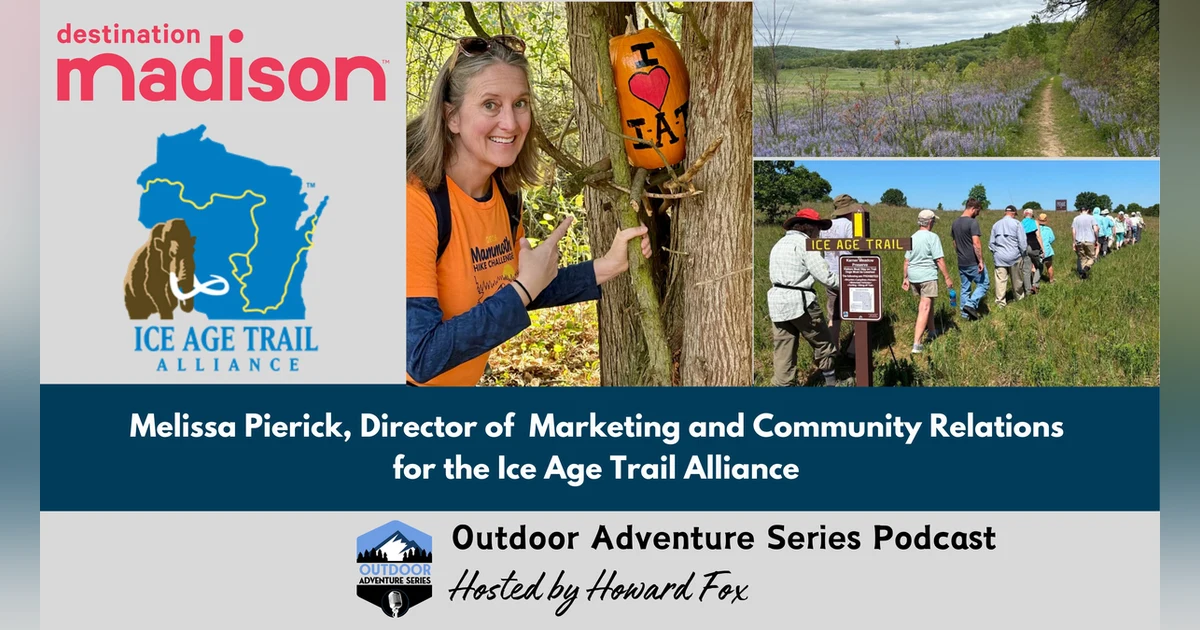
Welcome back to the Outdoor Adventure Series! In this episode, Howard sits down with Melissa Pierick, Director of Marketing and Community Relations for the Ice Age Trail Alliance. Melissa shares her personal journey of discovering the Ice Age National Scenic Trail—an incredible 1,200-mile adventure that winds through Wisconsin, right past the state capital of Madison.
Welcome back to the Outdoor Adventure Series! In this episode, Howard sits down with Melissa Pierick, Director of Marketing and Community Relations for the Ice Age Trail Alliance. Melissa shares her personal journey of discovering the Ice Age National Scenic Trail—an incredible 1,200-mile adventure that winds through Wisconsin, right past the state capital of Madison.
Melissa offers insight into the trail’s all-season appeal, the vibrant community of “thousand milers,” and the surprising beauty waiting around every corner. We’ll also learn about the Alliance’s dedicated volunteers, the communities supporting the trail, and how you can get involved— Plus, we'll get a sneak peek at upcoming events, including a unique, behind-the-scenes opportunity for attendees of the OWAA's annual conference in Madison this August to explore future trail segments and enjoy Wisconsin’s unrivaled hospitality.
Get ready to be inspired to get outside and start your own adventure on the Ice Age Trail!
DISCUSSION
Introduction and Welcome
- Introduction of Melissa Pierick, her role, and a fun fact about Madison 00:34, 00:49
Melissa Background and Trail Discovery
- Howard asks about her connection to the Madison area and the Ice Age Trail 01:01
- Melissa describes living in Wisconsin and not discovering the trail until 2019 01:16
- Reflections on discovering new places through the trail 03:49, 04:49
Ice Age Trail Details and "Thousand Miler" Journey
- The 1200-mile span of the trail 05:36
- "Thousand miler" achievement and culture 06:00
- Contrast with thru-hiking culture on other trails 06:06
Trail as an All-Season Experience
- Discussion about hiking in various seasons 07:55
Community Involvement and Support Along the Trail
- Local community engagement 09:10
- Overview of the Ice Age Trail’s passage through over 130 communities 10:09
- Description of official Ice Age Trail communities and their partnership with the Alliance 10:43
- Local business involvement and hospitality 11:15
Trail Use and Permitted Activities
- Permitted trail activities beyond hiking 12:50
- Trail is designated as a footpath (hiking, snowshoeing, skiing, running, backpacking, walking) 13:08
- Exceptions for biking on certain segments (urban paths, rails-to-trails) 13:27
- Rules for “thousand miler” qualification (must be on foot) 13:46
Trail Geography and Hiker Demographics
- Map overview and curiosity about hiker origins 14:14
- Explanation of trail route across Wisconsin and locations connected 14:31
- Hiker demographics: Wisconsin, nearby states (Illinois, Minnesota), international visitors 14:51, 15:29
Trail History and Organizational Structure
- National Scenic Trail designation in 1980 16:37
- Historical background: conservationist origins, failed national park effort, scientific reserve units 16:52
- Organization of the alliance, dating back to the 1950s 18:27
Volunteerism on the Ice Age Trail
- Volunteer numbers (around 2,000 annually) 19:12
- Wide range of volunteer activities 20:15
Website Tour and Online Resources
- Guided walk-through of the Alliance website 23:24
- Highlights of the interactive trail map and how it's updated 24:21
- Explanation of key map features 25:37
- Exploration of specific trail features (Devil’s Lake, ferry crossing, local ice cream shops) 28:43
- Elevation range and features 29:562
Upcoming OWAA Conference and Post-Tour
- Details about the August OWAA conference in Madison 38:17
- Description of the post-conference tour with the Ice Age Trail Alliance 34:36
Reflections on Meaningful Work and Community Impact
- “aha moments” and meaningful experiences 39:06
- Melissa discusses gratitude, the supportive hiker community, and the fulfilling impact of her work 39:21
"Obituary Builder" Insight
- Meaningful, memorable life activities over career achievements 43:00
LEARN MORE
Website: To learn more about the Ice Age Trail Alliance, visit their website at https://IceAgeTrail.org or their social sites:
Facebook 1: https://www.facebook.com/iceagetrail
Facebook 2: https://www.facebook.com/groups/525543867532782/
Instagram: http://instagram/iceagetrailorg
Destination Madison: https://www.visitmadison.com/
NEXT STEPS
Visit us at https://outdooradventureseries.com to like, comment, and share our episodes.
KEYWORDS
Ice Age Trail Alliance, Ice Age Trail, Thousand Miler, Monty the Mammoth, Destination Madison, Madison Wisconsin, National Scenic Trail, National Park Service, Outdoor Adventure Series, Podcast Interview, OWAA
#IceAgeTrailAlliance #IceAgeTrail #ThousandMiler #MontytheMammoth #DestinationMadison #MadisonWisconsin #NationalScenicTrail #NationalParkService #OutdoorAdventureSeries #PodcastInterview #OWAA #OWAA2026
My Favorite Podcast Tools:
- Production by Descript
- Hosting Buzzsprout
- Show Notes by Castmagic
- Website powered by Podpage
- Be a Podcast Guest by PodMatch
- Banner Customization by Nano Banana & Canva
Melissa Pierick - Ice Age Trail Alliance
Transcript
Melissa Pierick - Ice Age Trail Alliance
Outdoor Adventure Series
Howard Fox [00:00:01 - 00:00:46]
Hello, everyone, and welcome back for another episode of the outdoor adventure series. Today's episode is sponsored by Destination Madison, Host of the 2026 Outdoor Writers association of America's annual conference. During today's episode, we hope to share with you why Madison, Wisconsin and the surrounding communities in Dane county are the perfect destination for for family vacations, couples getaways, outdoor adventures, meetings, conferences and conventions. Our guest today is Melissa Pierick. She is the director of marketing and community relations for the Ice Age Trail Alliance. Melissa, it's a pleasure to have you on the podcast and welcome.
Melissa Pierick [00:00:46 - 00:00:56]
Hi, Howard. Thank you. I'm excited to be here. Hey, a fun fact about Madison, it is the only state capital to have National Scenic Trail running through it.
Howard Fox [00:00:57 - 00:00:59]
The only. Well, that's pretty darn special.
Melissa Pierick [00:01:00 - 00:01:00]
Yes.
Howard Fox [00:01:01 - 00:01:15]
And so how I want to talk about the, the, the trail, obviously, but I'd love to just get a little bit of background about yourself. Have you grown up in Madison area, Wisconsin, and has this trail been a part of your life?
Melissa Pierick [00:01:16 - 00:02:05]
Yeah. So I've spent most of my life in Wisconsin, surely all of my adult life here, and actually have lived in Wisconsin back when it was designated a National Scenic Trail. But I never really discovered the trail until about 2019. In my previous job, I would drive to work every day and pass these big brown dot signs that said Ice Age National Scenic Trail every day, twice a day. Never put it together like what it was. And then In December of 2019, I decided that I needed to finally embrace winter. I, despite living here my whole life, I do not like the cold. But I decided, okay, this is going to be the year I'm going to enjoy winter.
Melissa Pierick [00:02:05 - 00:02:12]
And I had a book that was sitting on my bookshelf called 60 hikes within 60 miles of Madison.
Howard Fox [00:02:12 - 00:02:13]
Oh, sweet.
Melissa Pierick [00:02:13 - 00:03:17]
And took it off and went on my first hike. One of my second hike, went on my third hike, which was only about 15 minutes from my house, and had this lovely, lovely three mile. I did an out and back. So six miles, but just a little three mile hike. Went through this little bit of pine forest, saw these beautiful winter marsh views, walked on a little bit of boardwalk, got done with the hike, and I thought, my gosh, this was just so beautiful. And along the way I had seen like Ice Age Trail, got back in my car, got my phone out, googled Ice Age Trail, and all of a sudden discovered that it's 1200 miles long and it spans the entire state of Wisconsin. I'm like, are you kidding? This is amazing. And so I quickly put that 60 miles or 60 hikes within 60 miles book away and started hiking all of the segments I could near my house and discovered so many gems like literally that I had no idea were there.
Melissa Pierick [00:03:17 - 00:04:03]
I then one night I was planning where I was going to hike the next day and I knew I had this segment of trail that was over here and I had this other segment of trail which I was knew was there. And I thought, well, how do those connect? Like where does the trail run? I still, you know, didn't quite understand the full path of it. So I had the electronic map out and I'm, you know, going in on the map and all of a sudden I discover there was a bike trail behind my house. So my, the house I lived in, the lot backed up to a street and then on the other side of the street there was this bike trail. I've been on this bike trail thousands of times. Biking, walking my dogs, taking my kids for a walk. It was the ice age trail and I did not know it. Cause I thought of it as the bike trail.
Melissa Pierick [00:04:04 - 00:04:49]
So that very next morning I went out to that trail and for the first time, despite the thousands of times I'd been on that trail, I saw the yellow blaze, which is the mark of the trail. And so I was like, I cannot believe I've lived here for 16 years and never knew this trail was there. So. And then from there on out it's just, I just, I've hiked, I'm now about 700 miles of the trail. I think I've eclipsed or no, 600 and some miles. 671 miles of the trail. And I just love it and I am so thankful for it. Trail has taken me to places again that I passed by on the interstate signs to Milton, signs to Janesville.
Melissa Pierick [00:04:49 - 00:05:03]
I'd never stopped in Milton. Why should I stop in Milton? And because of the trail I have discovered Milton and how great Milton is, you just, the trail takes you to so many great places, which it basically took me a lifetime to discover.
Howard Fox [00:05:03 - 00:05:14]
So I, I love that. And it's just by chance that aha moment and I really love it that the trail is like literally right behind your house.
Melissa Pierick [00:05:14 - 00:05:34]
So many times in my initial discovery of hiking the trail, I mean these places were all within half hour of my house. I'm like, I can't believe I didn't know this was here. Trail run by a babysitter that I had for my kids for a while, right down the street from her. I can't believe I didn't know this was here. Yeah, so it's great.
Howard Fox [00:05:35 - 00:05:59]
Very good. Now you mentioned you're on somewhere between 6 and 700 miles and you also mentioned that it is a 1200 mile trail. And when connect all the dots and the along the way, I would imagine that is a thousand is something special once you get to that, that pinnacle or definitely once you complete it.
Melissa Pierick [00:05:59 - 00:06:41]
Right, right. From what I've been told. So we have in the Ice Age Trail we have a strong community of hikers. And as opposed to some trails like the Appalachian Trail or the CDT or the PCT which they have a super strong through hiking culture, we get maybe 30 to 40 thru hikers a year. Majority of our hikers are these day hikers. But our day hikers really get obsessed with the trail and they want to finish the whole trail. And so when you finish the trail you're called a thousand miler. And from what I've witnessed of my friends who have become thousand milers, well, depending on how long it takes you.
Melissa Pierick [00:06:41 - 00:07:17]
But yeah, pretty much once you're kind of over that 900 mile mark, that thousand mile mark, then it becomes an all out sprint to the end because you're nearly there. But I am on my. Well, what year is this? 7th year of working on my thousand miler journey. Once I started working for the Ice Age Trail alliance, the number of miles that I get on the trail have plummeted. But I hike the trail, I just tend to hike the same segments that I've already done or I'm at an event so I'm near a segment or I've, you know, hiked a portion of a segment, not an entire segment. Anyway, I totally lost my train of thought.
Howard Fox [00:07:17 - 00:07:18]
Okay.
Melissa Pierick [00:07:18 - 00:07:32]
Yeah, yeah. So once you, you get close, it's, it's, you just, you want to be done. But now we're finding people who finish, start again and they want to see the segments in different season or different conditions.
Howard Fox [00:07:32 - 00:07:50]
So. Well, that was actually going to bring back a question for me. You live in the Midwest. I mean I lived in, I grew up in Michigan, Southeast Michigan. I lived in Chicago. We live for the summer. Winters can be brutal. Summers can be brutal in certain ways.
Howard Fox [00:07:51 - 00:07:54]
Would you say that this trail is an all season trail?
Melissa Pierick [00:07:55 - 00:08:31]
It absolutely is an all season trail. And I think probably the least popular season to hike is actually in the summer. Fall is by far the best season. Weather is great, the bugs are gone. Winter also is really pretty decent. Winter is pretty fascinating because you really get to see the terrain and you get to see the glacial features of the trail become much More prominent in off leaf. And when there's a coating of snow, spring is lovely. Summer it just, it's hot and you get bugs.
Melissa Pierick [00:08:31 - 00:08:55]
Right. Beginning of summer is bad for ticks. By August they taper off. So it's not as bad. But I'd have hiked in all, all seasons and I'm in some pretty bitter cold. I've decided that I will not hike when it's going to be below zero anymore because I've done that a couple of times and it was not fun. So. But if it's 10, I'm fine.
Melissa Pierick [00:08:55 - 00:08:59]
I can go hike, work up a sweat in a 10 degree day.
Howard Fox [00:09:00 - 00:09:05]
You can work up a sweat, lose a little weight, get stay in shape and all year round.
Melissa Pierick [00:09:05 - 00:09:09]
Right. Can also do that in a 95 degree humid day.
Howard Fox [00:09:10 - 00:10:05]
Okay, now, as a, as a trail, and you also mentioned some of the communities that you had passed through and finally stopped in. And do you find that the communities that are along the trail have some type of programming or. I did a podcast episode not long ago where along this trail there were pubs and you go get a beer. Okay. So after you're done, you knew there was a great little restaurant, cafe, bar, grab something to drink. Do you find that the communities support the trail and it really encouraged people, hey, come walk this segment of the trail. And by the way, here's a great restaurant, some shops. Go grab an ice cream now that you can, now that you're off the trail, get some, get some sugar back in your system.
Melissa Pierick [00:10:05 - 00:10:43]
Yeah, yeah, there are definitely communities. So first the Ice Age Trail. So yeah, it runs 1200 miles through the state of Wisconsin. We start in at the Minnesota border and a state park, interstate state park. The trail runs as far south as Janesville, which is almost on the Illinois border. And then it goes back up to Sturgeon Bay. And so the trail runs through or near something like 130 communities, I think. And of those 130 communities, and we're talking, I mean, a lot of these communities have no stoplights, but it's Wisconsin, so there's usually a bar.
Melissa Pierick [00:10:43 - 00:11:27]
But 30 of the communities, or 29 communities have become official Ice Age Trail communities. Okay. And this is a partnership agreement between the Ice Age Trail alliance and then the community where we kind of cross promote each other. And we do. Those communities are really hiker destinations, places that you go look if you're going to be staying overnight, you don't want to camp, you go look for that mom and Pop hotel in Merrill, or you go and get the coffee that's in Hatley, Wisconsin. And it completely depends because every community is different. The sizes of the community, the capabilities of the community. So we have some communities where the trail is definitely a promotion.
Melissa Pierick [00:11:27 - 00:11:57]
It's promoted. And the people in the, in the village and the towns really know the trail. They welcome hikers with open arms. They know what the hikers are doing. And that's. Some of the other ones, you know, are really, really tiny. Maybe they only do have that bar and a library, and they do what they can to be welcoming to hikers. I feel like in the past five years or so, overall awareness of the trail has increased in the state.
Melissa Pierick [00:11:58 - 00:12:28]
And so I think we're getting less and less people looking at hikers like, what are you doing? But. But there's still definitely awareness building to be done. And. But with more and more hikers getting out there, we encourage our hikers to, you know, when you are in a community, make sure you tell, you know, the bar owner, the pizza place that, hey, I'm here hiking the Ice age trail. So they start making that connection because. Excellent, you know, okay. Hikers aren't always the loudest group of people when they enter a town.
Howard Fox [00:12:29 - 00:12:34]
Yeah, I know. I just like, I want to get the water and take a rest, but.
Melissa Pierick [00:12:34 - 00:12:46]
Right, right. But we did have some thru hikers come through a few years ago, and they dubbed this the pub crawl through hike because they were able to every single day and have at least one beer on the trail.
Howard Fox [00:12:46 - 00:12:49]
So I, I love, I see. I love that.
Melissa Pierick [00:12:49 - 00:12:50]
Yeah. Yeah.
Howard Fox [00:12:50 - 00:13:08]
Is. Is the trails almost solely for hiking or are there other kinds of activities like mountain biking or fat tire biking available? I mean, that you could do if I didn't want to hike?
Melissa Pierick [00:13:08 - 00:13:46]
Yeah. So it is a designated footpath. So whether you want to snowshoe, ski, run, backpack, walk, it's a designated footpath. However, there are places where the trail overlays, like through the city of Janesville, it overlays their municipal path, which is a paved trail. So you could bike that trail. And there are also other places where we are on top of a rail to trail, so a bike trail, and so you can bike those. But if you want to become a thousand miler, so achieve the thousand miler status and say you completed the entire trail, you have to do that by foot, but.
Howard Fox [00:13:46 - 00:13:46]
Gotcha.
Melissa Pierick [00:13:46 - 00:14:14]
But yes, there's certainly areas where biking is allowed, but we are designated. And also, when people always ask, I don't want to do it out and back, how can I finish this segment? How can I do 11 miles without doing an out and back. And it's like, well you could take a bike, plant it at one end, hike, go back to hike and then bike back to your car. So there's all kinds of ways to incorporate biking if you wanted to.
Howard Fox [00:14:14 - 00:14:50]
Okay, now I was looking at the map and by the way, I would love to go to the website and you can kind of take us on a little tour of it. And I know that you have the interactive map there as well. I am curious. Before we do that, you talked about the, the 1200 miles. That's quite the distance from the north part of the state. You're, you know, you're, you can go close to the Illinois border. You're up to door County. Where are hikers coming from? I mean if they're not specifically from the state of Wisconsin, where are you finding they're coming in from to.
Howard Fox [00:14:50 - 00:14:51]
To.
Melissa Pierick [00:14:51 - 00:15:28]
I mean hikers come from all over. Last year we had a Japanese hiker on that thru hike the trail. We had another guy from the Netherlands. And what seems to be happening is people hike the big three. So they'll hike the Appalachian Trail, the Pacific Crest, the Continental Divide. Then they start looking at all the others because there's this really big desire to hike all 11 scenic trails. And so we're kind of in that next tier after the big three. And like the thru hikers that dubbed it the Pub Crawl thru hike, they use this as their cool down after the cdt.
Melissa Pierick [00:15:29 - 00:15:56]
So you know, people come from all around. We get, you know, a lot of the hikers are from Wisconsin. As I said, we're a big day day hiking, day hikers. We get a lot of people from Illinois as well, especially that northern Illinois. So Chicago on up, people come from Minnesota. I mean just all around. And now we became an official unit of the National Park Service a few years ago. So we've been a National scenic Trail since 1980.
Melissa Pierick [00:15:56 - 00:16:26]
But then there was like an administrative glitch basically which didn't include us as an official unit of the Park Service. So we were still part of the Park Service, but not a unit. So anyway, it got resolved a few years ago and since that we have this influx of people that come into our office wanting those National Park Service stamps for their books and so they'll go and hike. And so people come from all over. We had people from North Carolina the other day, Tennessee, like just, you never know what the day is going to bring.
Howard Fox [00:16:26 - 00:16:37]
Okay, okay. And I'm curious too, the, with the Ice age trail, when did it actually obtain its National Designation.
Melissa Pierick [00:16:37 - 00:17:27]
Yeah. So it became an official national Scenic Trail in October of 1980. So even though the trail dates back to the late 50s, the beginnings of the trail started in the Milwaukee area. There we had a conservationist, kind of one of the fathers of the trail, who really envisioned, he. He knew the glacial significance of the state and he felt really strongly that there should be a national park that's highlighted of glacial history. And he lobbied for a national park, like a ,ousand mile or 100 mile long national park. I think it was Thousand mile long National Park. And he got some people starting to think about it and then, you know, he ended up passing away.
Melissa Pierick [00:17:28 - 00:17:58]
And so the effort kind of died out for a little bit. But then there was renewed interest. Park Service said, no, we don't want to do a thousand mile national park. That would be crazy. But instead they established nine scientific reserve units, which scientific reserve units are places of glacial importance. Something glacial. You can see the impact of the glacier, these nine specific sites. And if you look, seven of the nine sites are on the trail.
Melissa Pierick [00:17:58 - 00:18:20]
So then things just progress. And eventually there was the first through hiker kind of went and proved out that, yeah, this could be a route. And so that was in the 70s. And so then in 1980, Congressman put a bill through to get the trail designated as a national scenic Trail.
Howard Fox [00:18:21 - 00:18:26]
Excellent. And when did the alliance take shape as a nonprofit?
Melissa Pierick [00:18:27 - 00:19:01]
Yeah, so the alliance actually dates back to the late 1950s. That was our, you know, predecessor organization. And so we are the official nonprofit that cares for the trail, that creates and maintains the trail, along with the National Park Service and the Wisconsin dnr. So the three entities together work together to create and maintain this, this trail of ours. And it is the volunteers that the Ice Age Trail alliance coordinates that really are the boots on the ground that do the work of creating and maintaining the trail.
Howard Fox [00:19:01 - 00:19:12]
And approximately how many volunteers are coming into and out of the organization, say, annually just to support the cause?
Melissa Pierick [00:19:12 - 00:19:44]
Yeah, so we get around 2,000 volunteers a year. But what's most incredible is the number of hours that those volunteers devote to trail related activities. So in the last fiscal year, it was more than 114,000 hours were devoted by these, about 2,000 people to trail related activities, which ranks us usually at the top of the National Park Service for volunteerism and hours, which is pretty incredible. You think about Yellowstone, you think about Glacier, all these giant parks, and there's the Ice Age trail.
Howard Fox [00:19:45 - 00:20:00]
Very good. Now, in addition to, say, admin work and answering phones and setting out letters and maps and et cetera, what are the range of volunteer activities that are taking place along the trail any given season?
Melissa Pierick [00:20:00 - 00:20:34]
Yeah, so I think all those volunteer activities that you just mentioned are really things that staff members do with the Alliance. So our volunteers. So we have. The alliance is made up of 19 volunteer chapters across the trail. So they usually, each, each chapter usually takes care of one or two or well, sometimes there's more, but the county's worth of trail. So they, they're the ones that maintain the trail. So if a storm comes along and a bunch of trees get knocked over, they go out there and saw the trees. They also mow in the areas where there's grassy path.
Melissa Pierick [00:20:34 - 00:21:08]
They mow those paths. We have trail building that happens. So the Ice Age Trail alliance organizes large scale trail building events, which are usually about five day events that happen through the trail building season. So May through October, we draw hundreds of volunteers for those five days and we can knock out a couple miles of trail, put some boardwalks in, make some stone staircases. So really cool trail building activities. And then along with those events comes the food side. Right. So we have whole kitchen staff that feeds these volunteers.
Melissa Pierick [00:21:09 - 00:21:57]
So many ways to get involved at trail building. But then we do have the outreach volunteers. So we have volunteers that are at an event today right now in Milwaukee presenting about all the volunteer opportunities with the Ice Age Trail. We have hike leaders. One of the cornerstone programs for the alliance is our Think Outside and our saunters programs. Think Outside is geared toward fourth graders and we provide a curriculum based presentation about the state's glacial history. And then they get to come and take a hike on the trail, a two or three mile hike. And we have a dedicated group of about 50 volunteers who want to and like to hike with 9 and 10 year old.
Melissa Pierick [00:21:58 - 00:22:57]
So there's just an endless variety really of, of opportunities. We have a mascot, Monty the mascot. He always needs somebody to be in, in, you know, in him. So we have one volunteer who goes to all kinds of kids events and dresses up as Monty the Mammoth. We also have an arm of our organization that is focused on habitat restoration. So we like to say, you know, we're putting scenic back in scenic trail because nothing worse than walking a crappy portion of trail. Wouldn't it be nice to instead walk amongst a beautiful prairie of native flowers? And so we have a whole lot of volunteers who are very passionate about cutting back invasive species and collecting seeds. So, you know, it's like the more gentle side of the trail, which I think is great because again, I am not a big Trail builder.
Melissa Pierick [00:22:57 - 00:23:15]
I don't like swinging a pickmatic or carrying duff buckets, but I will go and lap invasive species and I will collect seeds for hours. So it's just, it's really great. The alliance offers so many opportunities to get involved in a way that you want to.
Howard Fox [00:23:16 - 00:23:23]
Very nice. Well, I would love right now if we could take a quick tour of the website and if you're open for that. So.
Melissa Pierick [00:23:23 - 00:23:24]
Yeah.
Howard Fox [00:23:24 - 00:23:38]
Excellent. So with the. Hopefully technology works today. Right. So if everything worked right, you should be seeing the page. Your website. Excellent. And there's.
Howard Fox [00:23:38 - 00:23:42]
I love the logo, by the way. And there's Monty. Yeah.
Melissa Pierick [00:23:42 - 00:23:42]
Thank you.
Howard Fox [00:23:42 - 00:23:44]
I love the colors. Love the colors.
Melissa Pierick [00:23:45 - 00:23:51]
I was just going to mention we have license plates, so if you live in the state of Wisconsin, you can get an Ice Age trail license plate.
Howard Fox [00:23:51 - 00:23:52]
I love it. I love it.
Melissa Pierick [00:23:52 - 00:23:53]
It's pretty fun. Yeah.
Howard Fox [00:23:53 - 00:24:21]
You know, it's funny, I always share when I'm interviewing destinations like Madison or Parts living here in Nevada, I'm always looking for my next place to live. And once, even though I lived in Chicago for many years, I definitely could picture myself living in Wisconsin, taking advantage of this wonderful trail that goes throughout the state. So take us on a little tour here. Where should we go?
Melissa Pierick [00:24:21 - 00:24:36]
Yeah. So I think if you click on that trail map and that's probably the most clicked link on our website and for good reason. This takes you to our. We call it our hiker resource map. So hopefully it'll load here.
Howard Fox [00:24:37 - 00:24:41]
Yeah, it could be my Internet connection, but I think we're getting there slowly.
Melissa Pierick [00:24:41 - 00:25:14]
Right. So this is always the most up to date map that you will find for the Ice Age trail. You know, the Ice Age Trail alliance does. Does create an atlas and a guidebook every few years. Of course, those get outdated every year as we build new trailers. We also have the Far out app, has the Ice Age trail maps and those are updated pretty frequently. But there's still some time that lags between Far out updates. But this update is.
Melissa Pierick [00:25:15 - 00:25:41]
Or this map is updated by our GIS staffer. And as soon as a project is done, if the project closes on Sunday, this map will reflect the new trail by Wednesday usually. Um, so you can drill down into this and really just explore the trail. So if you go those little. The TC icons that indicates a trail community.
Howard Fox [00:25:42 - 00:25:50]
Okay. Okay. By the way, I was looking at this yesterday. What is the significance of the. The more solid lines versus the dots?
Melissa Pierick [00:25:50 - 00:26:15]
Yeah. So the Ice Age trail is a trail in progress. It is. When complete, it'll be about 1200 miles. Right now we have 711.4 miles that are blazed of the trail. So blaze just means their official trail. Again, because our trail goes through communities. We do have a lot of urban trail.
Melissa Pierick [00:26:15 - 00:26:33]
So we don't like to use the term off road when we talk about our trail, but so we'll just say blazed, completed trail. So the solid lines are the blazed completed trail, and then the dotted lines represent the connecting routes between the blazed completed segments.
Howard Fox [00:26:33 - 00:26:34]
Okay.
Melissa Pierick [00:26:34 - 00:26:58]
And the connecting routes that are suggested are not always the shortest distance between two segments, but they are either more scenic or safer to hike along. So back roads, old country highways, that kind of thing. There are shorter distances, but you'll probably be walking, you know, next to semis, which is not great most of the time.
Howard Fox [00:26:58 - 00:26:59]
You don't want that. All right.
Melissa Pierick [00:26:59 - 00:27:02]
Yeah. So, and then in the center, since
Howard Fox [00:27:02 - 00:27:12]
we're looking, I was going to say, I think I might have actually been on your trail because I have spent a little bit of time up in Door county, so. Yeah, I mean, perhaps.
Melissa Pierick [00:27:12 - 00:27:18]
Right. Probably if you were on any of the. There's a bike trail that's up there, so you never know.
Howard Fox [00:27:20 - 00:27:22]
I interrupted you, but you were going to say something else.
Melissa Pierick [00:27:22 - 00:27:30]
No, I was just going to point out that circle in the middle of the trail there. Some people call it a donor. We call it the bifurcation.
Howard Fox [00:27:30 - 00:27:31]
Okay.
Melissa Pierick [00:27:31 - 00:27:51]
So that actually is a political compromise of sorts. The east side of that circle is more culturally significant. So the eastern side goes near Aldo Leopold's stopping grounds and his shack and John Muir's boyhood home.
Howard Fox [00:27:52 - 00:27:52]
Okay.
Melissa Pierick [00:27:53 - 00:28:26]
So. But then the western side is more glacially significant. And when people were first trying to set out what the trail was going to be, there's a big debate and people were very passionate that it should be on the east. No, it should be on the west. And at the end of the day, they said, we're not going to decide. We'll let the hikers decide which way they want to hike. So when you are through hiking the trail, or if you are on that quest to be a thousand miler, it is only required to do one side of the bifurcation.
Howard Fox [00:28:26 - 00:28:27]
Okay.
Melissa Pierick [00:28:27 - 00:28:31]
So. And at this point, both sides are about even, mileage wise. So.
Howard Fox [00:28:32 - 00:28:37]
Okay, this is interesting here. Down. Okay, it does work. How about that?
Melissa Pierick [00:28:39 - 00:28:40]
Oh, yeah.
Howard Fox [00:28:40 - 00:28:43]
This little detour.
Melissa Pierick [00:28:43 - 00:29:07]
Yep. So that goes through Devil's Lake State park, which is probably Wisconsin's most famous state park. Gets huge visitation every year. It's beautiful. And the trail goes around through the park there. And actually, if you keep Scrolling in, you see that there's a connector route over. Oh, wait, go down south. Yeah.
Melissa Pierick [00:29:07 - 00:29:22]
Goes down across the river there. There's actually a ferry that runs. It's a free ferry that runs across the river there. So part of the trail is on a ferry that you stand on and get taken across. Only takes about five minutes. So.
Howard Fox [00:29:22 - 00:29:23]
Sure.
Melissa Pierick [00:29:23 - 00:29:30]
That's a fun thing. And the best part about the ferry and the trail right there is that there's an ice cream place on either side of the.
Howard Fox [00:29:31 - 00:29:34]
You gotta have your establishments there.
Melissa Pierick [00:29:34 - 00:29:35]
Yeah.
Howard Fox [00:29:35 - 00:29:41]
Excellent. Take care of the visitors. All right. Yeah. This map is very cool. I love this.
Melissa Pierick [00:29:41 - 00:29:50]
Yeah. And you can see places to camp. You can put different filters on and see hunting season effects. Yeah. Okay.
Howard Fox [00:29:51 - 00:29:56]
Just curious. If you don't know the answer, that's quite all right. But I was just looking at the elevation profile.
Melissa Pierick [00:29:56 - 00:29:57]
Yeah.
Howard Fox [00:29:57 - 00:30:05]
And I'm probably going to mess something up here. But do you have a sense of what the elevation range is from.
Melissa Pierick [00:30:07 - 00:30:30]
My gosh, we were just trying to figure this out the other day because. Let's see, it is in our. Yeah. The highest point on the trail is Lookout Mountain in Lincoln County. I'm reading this out of our guidebook. It's 1,920ft. The lowest point, 580ft, is along the shore of Lake Michigan.
Howard Fox [00:30:30 - 00:30:32]
Gotcha. Very cool.
Melissa Pierick [00:30:32 - 00:30:33]
So, yeah.
Howard Fox [00:30:33 - 00:30:36]
Excellent. Well, let's go back to the website.
Melissa Pierick [00:30:37 - 00:30:37]
Okay.
Howard Fox [00:30:37 - 00:30:48]
And so we've got the map. We've. You've got merch. I was looking at the merch store yesterday. So if I do any segment of the Ice Age trail, I have to have my merch.
Melissa Pierick [00:30:49 - 00:31:26]
There you go. That's right. My. My kids make fun of me because wherever I go when I'm hiking, I always wear an Ice Age trail shirt. And I was recently over in Italy with my sisters and we were hiking the path of the gods over in the Amalfi coast. And I have my Ice Age trail shirt on. And, you know, kids saw the pictures of me and they're like, mom, why do you wear those shirts everywhere? I'm like, because it's a good thing to talk about. And lo and behold, as we're hiking the path of the gods, someone passes by me, kind of does a double take and says, where are you from? And I said, oh, Wisconsin.
Melissa Pierick [00:31:26 - 00:31:31]
Turns out they were also from Wisconsin. They've hiked the Ice Age trail, like, nice.
Howard Fox [00:31:31 - 00:31:35]
Well, you're. You are. You are a brand ambassador.
Melissa Pierick [00:31:35 - 00:31:39]
That's right. However I go, plus the chagrin of
Howard Fox [00:31:39 - 00:31:43]
my teenagers, they'll become Adults soon enough, right?
Melissa Pierick [00:31:43 - 00:31:44]
Yeah.
Howard Fox [00:31:44 - 00:31:44]
Okay.
Melissa Pierick [00:31:44 - 00:32:07]
So I think what. Yeah. So you could see our website has a ton of information. We are actually going to be revising the website probably before September. We're going to launch a new site. A lot of the same information will be there, just laid out a little differently. But we have highlights to all of the. The blog articles, whatever is happening on the trail.
Melissa Pierick [00:32:07 - 00:32:37]
But if you go up to let's go back to the Explore tab and you can see there's a segment by segment tour, which is pretty cool. It is a story map and it will take you on a virtual segment. You can go through every single segment, see a picture, get a little description. So we think that's pretty nice. We use this one a lot when we're out at events.
Howard Fox [00:32:38 - 00:32:48]
I love this. I would not be at a loss for places to visit if I was in full time in Wisconsin. This is gorgeous.
Melissa Pierick [00:32:48 - 00:33:12]
Yeah. And we hear that again and again from people who've lived here all their lives and also from people from other states who come and they will say, I never knew Wisconsin was this beautiful. The state tends to focus on a few key areas. Right. Of for tourism, whatever. Sturgeon Bay, Door County. It's beautiful. Devil's Lake.
Melissa Pierick [00:33:12 - 00:33:26]
You see Devil's Lake in a lot of pictures of Wisconsin. But there are honestly so many gorgeous places that the trail takes you to that don't get a lot of. So I love that.
Howard Fox [00:33:26 - 00:33:28]
This is fantastic. I love this.
Melissa Pierick [00:33:28 - 00:33:43]
Yeah. So you can just like click through and look and see what every segment is. So it's really cool. And then on this map too, you can click in the descriptions like St. Croix Falls, there's a trail community and that will take you to.
Howard Fox [00:33:43 - 00:33:44]
Oops.
Melissa Pierick [00:33:44 - 00:33:44]
Well, that was.
Howard Fox [00:33:44 - 00:33:47]
Well, we didn't want to see that. All right, I won't talk.
Melissa Pierick [00:33:47 - 00:34:06]
Well, we have itineraries for each of our trail communities on our website. So say you want to go to Merrill, Wisconsin. Well, the itinerary gives you a few places that you could stay. Some a brewery to check out. Just gives you an idea. Does it plan your trip but just plant some seeds for you.
Howard Fox [00:34:06 - 00:34:19]
Okay. So I am curious with the, with the conference coming up in August. It is if it's humid now, I imagine it's going to be even more humid and a little hotter.
Melissa Pierick [00:34:19 - 00:34:19]
Yep.
Howard Fox [00:34:19 - 00:34:35]
You are going to. Hopefully you'll have a booth at the. At the conference at the center in Madison. But there's also a post tour that is being planned for our members. Do you have any. An idea what that's what that is going to be like when, when we.
Melissa Pierick [00:34:36 - 00:35:10]
Yeah. So we're, we're pairing up with Destination Madison to offer this post tour, which I think is going to be really cool and maybe something a little different than what you'd be used to. We're going to start at the office here, have a little introductory time and then we're going to go to one of our showcase segments which is called Table Bluff. It's about five minutes from the office. We'll, we'll drive out there. So no one needs to walk out there. And we're going to take a hike on this segment. It's about 3 miles, 3.3 miles hike.
Melissa Pierick [00:35:10 - 00:36:10]
Really lovely property over the past two, three decades. A ton of work went into restoring the land that the trail runs through. So we'll talk a little bit about that habitat restoration side of our work, putting the scenic and scenic why we do it and just talk about trail building a little bit and then we're going to take you on future trail. So back in December, the alliance closed on the acquisition of a property that adjoins with this segment we're going to do. And so we're going to go on a little bushwhacking for about a mile and you see, it's a chance to see something no one else really has seen. And you'll get to see where we think the trail is going to go. We'll talk about, hey, what goes into building the trail, what the steps are. It takes a while, at least a full year because you want to see the trail proposed trail line in all seasons.
Melissa Pierick [00:36:10 - 00:36:36]
So see what it looks like in the spring, the summer, fall, how does winter melt affect it? But yeah, so we'll walk a proposed trail line and then we're going to conclude the tour with good old Wisconsin Grill out back at the office. So if it is hot, we'll be able to hang out in the air conditioning a little bit or if it's nice, we have picnic tables. We have a really nice setting for our office which is right on trail.
Howard Fox [00:36:36 - 00:36:48]
So we'll have now the. Do you have a sense right off the top of your head when this will this tour be in the morning? Is it going to take us a half a day? Full day?
Melissa Pierick [00:36:48 - 00:37:00]
It's going to. Yep. It'll start in the morning and I think we finished by like 12:30, so it will conclude with lunch. So. Okay, we'll get some racks and cheese curds and all the things.
Howard Fox [00:37:00 - 00:37:08]
Okay. So if I, if I end up staying over instead of getting home, I'll just head home, take a late flight back to Las Vegas.
Melissa Pierick [00:37:08 - 00:37:12]
Okay. Yeah, take a late flight. I think that's all. When all the flights leave for Vegas, actually later.
Howard Fox [00:37:12 - 00:37:14]
That. That's good to know. Okay.
Melissa Pierick [00:37:14 - 00:37:38]
Very good. Yeah. Oh, it'll be a fun day. And like I said, I think we just tried to think about something that would be a little different because you can, you can go on a hike anytime and it's great, but, you know, to be able to see, hey, this is where we're going to go. And then if you follow us in a couple of years when we build the trail, maybe you even want to come back and be part of that trail building effort. That would be kind of.
Howard Fox [00:37:38 - 00:37:56]
There you go. There you go. Now, I do see from the website, we. There is the trail map we just saw that you can donate. You got the merch, you've got news and events, more about the alliance. You also have the social sites, Facebook, Instagram, and I always forget what that one is. TikTok.
Melissa Pierick [00:37:56 - 00:38:01]
Yeah. Yeah, we have a very small TikTok page because TikTok takes a lot of work.
Howard Fox [00:38:01 - 00:38:33]
It does, it does. Well, thank you for taking us on this tour. I love it. I want to head back to just you and I. So we've talked about the conference for our listeners and for our, my fellow OWAA members. The conference is in August, August 22nd through 24th. The tour with the Ice Age alliance is going to be on the 25th, which is a Tuesday. So this is an opportunity to stick around, get some exercise.
Melissa Pierick [00:38:33 - 00:38:34]
That's right.
Howard Fox [00:38:34 - 00:39:21]
I may need to bring my hiking poles, I think, but I think this is going to be a lot of fun and great way to explore a little bit of Wisconsin. And with the, with the Ice Age Trail Alliance, I think that's wonderful. Melissa, before we head out today, I am curious as you kind of look back at your career and this aha moment that you had earlier of, of when you first discovered, like, literally, the trail is right out your back door. What are some. What's a aha moment? That, like, oh, wow, I get to do this work and not only help be a brand ambassador for Wisconsin, but also help make a difference in people's lives through this work that you're doing. What's your aha moment?
Melissa Pierick [00:39:21 - 00:39:36]
So I think first, everybody that's on staff here at the alliance, we're, I don't know, 22 or three people. I think we're all incredibly grateful for our jobs and like, we know what we do is really special.
Howard Fox [00:39:37 - 00:39:37]
And,
Melissa Pierick [00:39:39 - 00:40:15]
you know, I Came from a job where I worked at a telecommunications company like Internet and Phone. No one listened to the emails we sent. Like it was, it was terrible for communicating. I came here and people open our emails. People come to our events. Anytime we have a request, whether it's to donate or just to support something, our supporters come out. And it just, it really makes my job easier because I know everything I do, there is definitely a reason and a purpose for it. That's not saying my job is easy because.
Melissa Pierick [00:40:15 - 00:40:49]
And it's not stressful. I thought I'd be coming to a nonprofit and be way less stressful, but it's not. But it's stress for good reason. And I think it's, it's funny I go on hikes because again, I'm trying to become that thousand miler. And a lot of people I hike with, who I'm friends with know where I work and what I do. Even though I started hiking before I got this job, so people knew me before I started here, but I still, I don't make it known. Like when I hike sometimes I just want to hike. I don't want to be Alliance Melissa or work Melissa.
Melissa Pierick [00:40:49 - 00:41:21]
So I try and keep it under the radar, like what my job is sometimes. And I was on a hike with somebody I just met and I didn't tell them what I did. And they were telling me about how it's so amazing. They hear about the Ice Age trail all the time now. And I hear about it on the news and I see it on the, in a magazine or whatever. And I just thought to myself, like, yes, it's working. Once we start putting concerted effort towards building awareness, you know, our message is getting out there. And so I think that's cool.
Melissa Pierick [00:41:22 - 00:42:07]
And then also too, like anytime we go to a volunteer or we host a volunteer event, last year we did an invasive species removal like an invasive species awareness day with the dnr. So it was kind of a DNR event. But we decided to host an activity on near the trail. And it was so humid and so hot. It was in June of last year. Like I'm talking like 95 degrees plus probably more than a hundred by the time you add in the heat index. And so many people came out and it like it was, we had to be in long pants and long shirts because we were going through brush cut and brush back everything and terrible work. But people are so happy to do it.
Melissa Pierick [00:42:07 - 00:42:40]
And I just, I just think it's really amazing. And so I love, I love getting out to events and I Love meeting the people who are building this trail. And what amazes me is the number of people who come to trail building events who could care less about hiking. They just want to build this trail. And I think that is amazing because you were creating this for me and my friends who are going to come tramp on it for the rest of our lives, but they just want to be out and they just want to build a trail and help leave a legacy, and I think that's really cool.
Howard Fox [00:42:41 - 00:43:00]
Excellent. Excellent. Before we head out, one last feature of our podcast is what I call the insight to go. And in the notes that you had shared as I was preparing the episode, you used a term that. It kind of reminds me of my metal shovel, but in a way. But obituary builders.
Melissa Pierick [00:43:00 - 00:43:19]
Yep. So, yeah. So I think. I don't know if I came up with this term or I don't think I heard it anywhere. I don't know. But anyway, it's like a resume builder, right. For so long, you work in your career and you're trying to get the certifications, get the promotions, build the skills. Right.
Melissa Pierick [00:43:19 - 00:44:10]
So you can build that resume. And I think instead of being so focused on that, as individuals, we should be focused on building our obituaries. Right? Because the last thing I want to read, and it makes me so sad when I read someone's obituary and I just find out that they worked at all of these places and what their titles were, and I'm like, that's all. That's it. They just worked a bunch of places, and this is where they went to high school. So I always think about in terms of obituary, like, what do I want in my obituary? What kind of fun things will my kids be able to say about me? You know, hopefully they'll be able to say, hey, our mom was a thousand miler. And so I think we just need to think about, like, right, all of those things we could do, how we make our life more fulfilling, more exciting, like more interesting. Right.
Melissa Pierick [00:44:10 - 00:44:19]
What kinds of things do we really want people to know about us? So, yeah. So an obituary builder. What activity will you do today that could be in your obituary?
Howard Fox [00:44:20 - 00:44:44]
I love it. I love it. Well, Melissa, it's been a pleasure to have you on the podcast. I look forward to meeting you and your peers at the annual conference of the OWA in August. And I am going to go back and look at my itinerary. I do think I need to do some walking over here first to get. But last time I went bushwhacking was in Alaska, and it's like, oh, my God.
Melissa Pierick [00:44:44 - 00:44:49]
But okay, this is in Alaska bushwhacking. This is Wisconsin bushwhacking.
Howard Fox [00:44:49 - 00:44:50]
Okay.
Melissa Pierick [00:44:50 - 00:44:57]
All right, you know what? And if, you know, you decide you don't want to do the bushwhacking, we can always have a car to take you back. It's fine.
Howard Fox [00:44:58 - 00:45:01]
I can see now that's, I will never let that one down.
Melissa Pierick [00:45:01 - 00:45:04]
So take you up to the other side that you can come down.
Howard Fox [00:45:04 - 00:45:42]
There you go. There you go. Well, listen, I really appreciate you taking time to join us on the podcast today. And we're going to make sure we have the backlinks to the Ice Age Trail website as well as your Facebook pages. You've got a group page and Instagram and TikTok, and those will be in the show notes. And really, again, for our listeners and for my peers at the owaa, this sounds like a great then to participate in if you're going to stay in Madison once the conference ends. So we'll, that'll take place on the morning of August 25th. And what a great, great thing to do.
Howard Fox [00:45:42 - 00:45:44]
So, Melissa, thank you so much.
Melissa Pierick [00:45:44 - 00:45:49]
Thanks. Yeah, we'd love to host you guys and take you on a tour and show you how great the Ice Age Trail is.
Howard Fox [00:45:49 - 00:45:51]
So sounds like a plan.
Melissa Pierick [00:45:51 - 00:45:53]
And feed you rats, cheese curds.
Howard Fox [00:45:53 - 00:46:00]
Rats and cheese curds. How can you go wrong? I love it. Listen, stay in the line. We're going to do a very quick close and you and I can have a final chat.
Melissa Pierick [00:46:00 - 00:46:01]
Okay? Okay.
Howard Fox [00:46:01 - 00:46:52]
All right, folks, you've just been listening to this episode with Melissa Pierrick. She is with the Ice Age Trail Alliance. I think we got a wonderful overview of the Ice Age Trail, its significance and really the opportunities to showcase really the beauty of what Wisconsin is. And having lived in the Chicago and Northern Illinois, it, it's more than just Milwaukee. I mean, Milwaukee, God bless them, and some of the other cities. You've got the lake. But as you go into the state, there's just some wonderful exploration you can do. And really the significance of the glaciers and the receding glaciers and how it has helped form really, this, this trail that, that is now available, 10001200 miles of trails that are available to you now for this website.
Howard Fox [00:46:52 - 00:47:29]
Website for this show. You can find us on our website, outdoor adventureseries.com you can find us on our Facebook and LinkedIn pages. Outdoor adventure series. The video of this episode will be up on our YouTube channel. And of course, you can listen to this episode. Perhaps as you're walking along part of the trail, you can find us on wherever you get your podcast from. And really folks, we do want to thank the great folks at Destination Madison for sponsoring this episode of the Outdoor Adventure Series. Thanks to their support, we can introduce you to guests like Melissa.
Howard Fox [00:47:29 - 00:47:50]
And to begin planning your Madison getaway or outing, visit the Destination Madison website@visitmadison.com Until next time, wherever you go, whatever you're doing, go out there and have a fantastic day. And we look forward to having you join us on our future episode of the Outdoor Adventure Series podcast. Take care.